Startup investing was once the exclusive domain of venture capital firms and high-net-worth individuals. That is no longer the case.
Changes in UK financial regulation over the past decade have opened early-stage investing to a much broader group of people. Today, retail investors can back startups from £20, gain exposure to some of the most innovative private companies in Europe, and do so through regulated, transparent platforms like Republic Europe.
But opening access does not mean removing complexity. Startup investing carries real risk, and understanding how it works before you commit capital is essential. This guide walks through everything a first-time investor needs to know, from the mechanics of equity crowdfunding to how to build a sensible approach to a high-risk asset class.
Step 1: Understand What You Are Actually Investing In
When you invest in a startup through an equity crowdfunding platform like Republic Europe, you are purchasing shares in a private company. Unlike buying shares in a publicly listed company, you cannot sell those shares on an open market whenever you choose. Your investment is generally illiquid, meaning your capital may be tied up for several years until a formal exit event such as an acquisition or IPO.
That said, Republic Europe operates the only fully functioning early-stage equity secondary market in the UK, which provides a degree of flexibility that most private company investments do not offer. Through the Secondary Market, shareholders can list their shares for sale in lots as small as £10, giving early investors the opportunity to potentially realise liquidity before a formal exit. While the secondary market does not guarantee a buyer or a particular price, it meaningfully changes the liquidity profile of startup investing compared to platforms that offer no exit pathway at all.
What you are ultimately betting on is the future value of the company. If the startup grows significantly and reaches a liquidity event, your shares may be worth considerably more than you paid. If the company fails, which many startups do, you may lose some or all of your investment. Understanding both the potential upside and the realistic downside is the right place to start.
Step 2: Understand Who Regulates Republic Europe and What That Means for You
Republic Europe (operated by Seedrs Limited) is authorised and regulated by the Financial Conduct Authority, with Firm Reference Number 550317. You can verify this directly on the FCA’s Financial Services Register. For investors based in Ireland and across the EU, Seedrs Europe Limited (also trading as Republic Europe) is regulated by the Central Bank of Ireland.
What this means in practice is that Republic Europe is held to ongoing compliance obligations across every part of the investment journey. These include conducting investor appropriateness assessments before you can invest, maintaining transparent risk disclosures on every campaign, and administering investments under a regulated nominee structure that holds shares on your behalf. That nominee structure means you do not need to manage share certificates or legal transfers directly, Republic Europe handles that administration, and your entitlement to the underlying shares is protected within the regulated framework.
When you register on the platform, you will be asked to complete an appropriateness assessment. This is not a formality. It is a regulatory requirement designed to confirm that you understand the risks involved in startup investing before committing any capital. Answering honestly is in your interest.
This regulatory foundation does not remove the inherent risk of investing in early-stage companies. But it does mean you are investing through a platform that operates to a defined legal standard, with clear obligations around how your money is managed and how your investments are recorded.
Step 3: Learn the Different Ways to Invest on Republic Europe
Not all startup investments in the UK work the same way. Understanding the main structures will help you make more informed decisions.
Equity shares. The most common structure on our platform. You purchase shares in the company and become a shareholder, with rights proportional to the terms of the share class you are issued.
Convertible notes. A form of debt that converts into equity at a future funding round. They typically include a discount rate or valuation cap that rewards early investors when conversion occurs.
Funds. We also offer access to diversified funds that invest across a portfolio of startups, rather than requiring you to select individual companies. This reduces single-company risk but also means less control over where your capital is deployed.
SEIS and EIS. The Seed Enterprise Investment Scheme (SEIS) and Enterprise Investment Scheme (EIS) are UK government-backed tax relief programmes designed to encourage investment in early-stage companies. SEIS offers up to 50% income tax relief on investments up to £200,000 per tax year. EIS offers 30% relief on investments up to £1 million. Both schemes also provide capital gains tax benefits.
When a startup carries SEIS or EIS eligibility, the risk-reward profile of investing in it shifts. The tax relief effectively reduces your net cost of entry from day one. For example, a £1,000 SEIS-eligible investment costs you £500 in real terms after claiming 50% income tax relief, which means the company only needs to return more than £500 for you to be in profit rather than the full £1,000. On the downside, if the company fails entirely, SEIS loss relief allows you to offset the remaining loss against your income tax bill, which can reduce your effective loss depending on your tax rate. EIS provides similar downside protection. On the upside, any gains made on SEIS and EIS shares held for the qualifying period are exempt from Capital Gains Tax.
If a startup is SEIS or EIS eligible, this is worth factoring carefully into your assessment before you invest. Tax treatment depends on individual circumstances and is subject to change.
Step 4: Assess the Opportunity
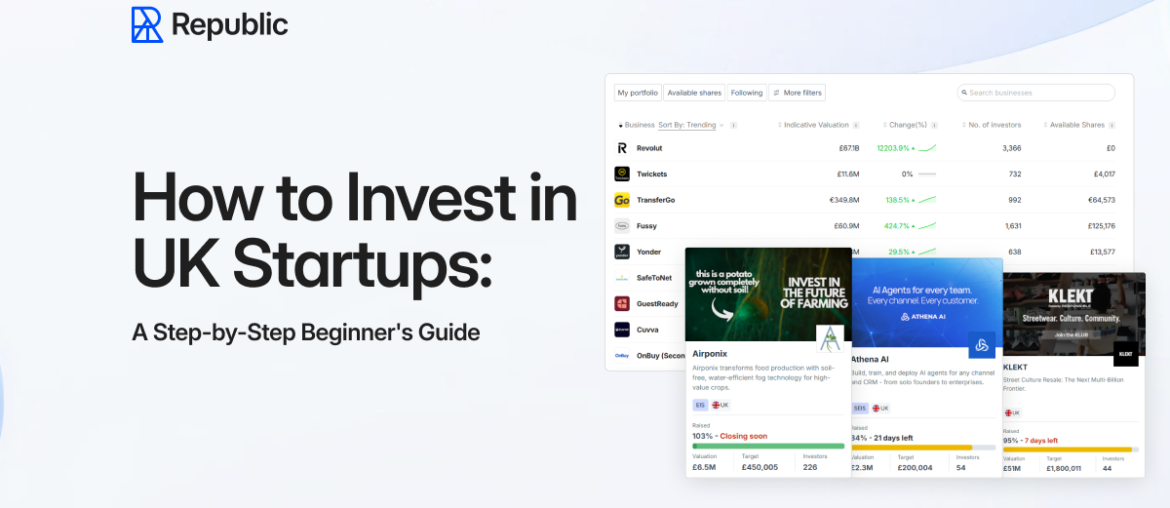
A startup’s campaign page on Republic Europe will typically include a pitch, details of the round, the valuation at which shares are being offered, and the company’s plans for the capital raised.
Some questions worth working through for any opportunity:
What problem does the company solve, and how large is the market? Early-stage companies often operate in niches. Understand whether the opportunity is genuinely large or whether the company is solving a problem for a small and unlikely-to-grow audience.
What is the current traction? Revenue, user numbers, partnerships, and other measurable indicators of real-world demand may help tell a well-rounded story.
What is the valuation, and how does it compare to the stage? A pre-revenue company raising at a £10 million valuation may have a different level of risk to a company generating £1 million in annual recurring revenue at the same valuation. Benchmark against comparable deals where you can.
What happens to your shares in a down round? Understand the share class structure and any provisions that could dilute your holding or subordinate your shares in future funding events.
Step 5: Think About Portfolio Construction
The expected return profile of startup investing only works at the portfolio level. For a retail investor, a robust approach involves spreading exposure across a larger number of deals over time, which can help smooth the impact of any single failure.
A few practical principles for building a startup portfolio:
- Only allocate capital you can afford to have illiquid for five to ten years, and potentially lose entirely.
- Diversify across sectors, stages, and company sizes.
- Do not let recent performance on the platform drive your decisions. Past campaigns succeeding does not predict future outcomes.
- Treat SEIS and EIS relief as a risk reduction mechanism, not a guarantee of return.
Step 6: Complete Your KYC Journey
Republic Europe will require you to complete a KYC (Know Your Customer) registration process before you can invest. This includes:
- Identity verification, which usually involves a passport or driving licence and proof of address.
- An appropriateness assessment to confirm you understand the risks involved.
- Self-certification of your investor category. In the UK, this usually means confirming you are a high-net-worth investor, a sophisticated investor, or that you will restrict your investments in unlisted shares to no more than 10% of your net investable assets per year.
Once your account is active, you can browse live campaigns, review documentation, and make investments. We will hold funds in escrow until the raise completes. If a campaign does not reach its minimum funding target, your investment is returned.
Step 7: Monitor Your Portfolio and Stay Informed
After investing, your relationship with the company does not end. Through our platform, the companies provide ongoing shareholder updates, which may include company accounts, trading updates, and notifications of material events such as new funding rounds, acquisitions, or changes to the team.
Reading these updates is worthwhile. They help you track whether the companies you have backed are progressing as anticipated, and they provide context for any future follow-on investment opportunities that may arise.
A Note on Risk
Start your startup investing journey with Republic Europe
Republic Europe is an FCA-authorised equity crowdfunding platform connecting investors with startups across the UK and Europe. Browse live campaigns, explore SEIS and EIS-eligible opportunities, and build a startup portfolio alongside a community of over 3 million members globally.
Create your free account and start investing
Republic Europe is authorised and regulated by the Financial Conduct Authority. This article is for informational purposes only and does not constitute financial or legal advice. Capital is at risk and you may not get back the amount invested. Tax treatment depends on individual circumstances and may be subject to change.