


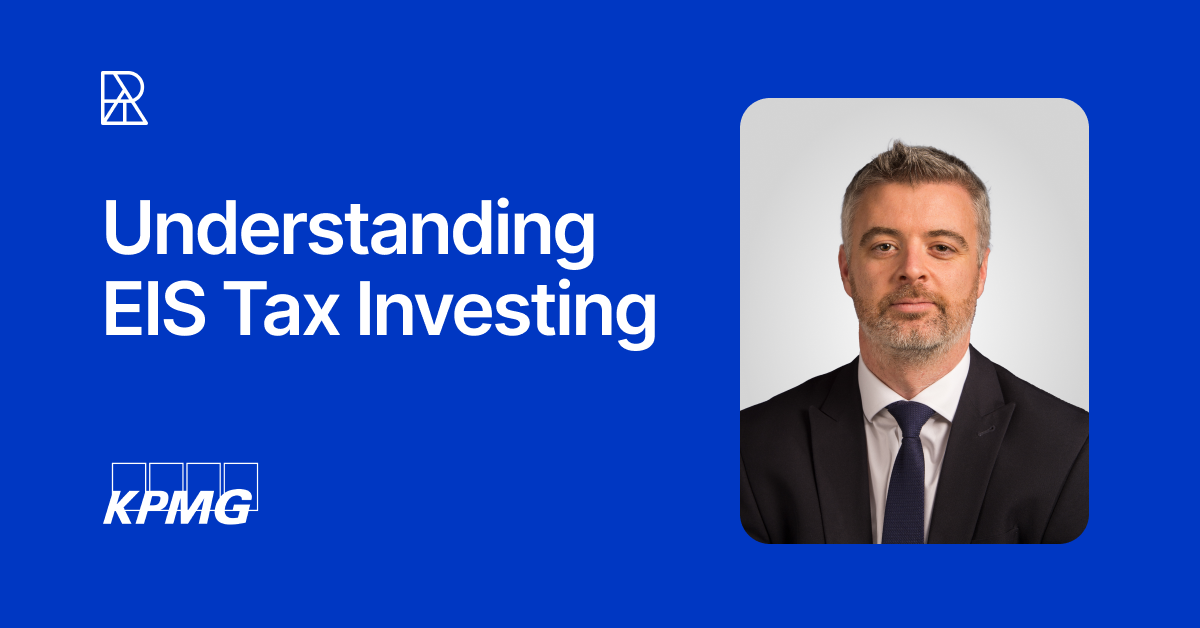
Graeme Whitfield, a Private Client Tax Director from KPMG, shares his thoughts on how to best leverage EIS investment opportunities.
Understanding the Enterprise Investment Scheme (EIS)
The Enterprise Investment Scheme is a UK tax incentive scheme designed to encourage private investment into small, high-growth companies. It provides tax reliefs for investors who subscribe for shares in qualifying companies. These companies tend to be in their early stages, often with limited access to traditional forms of funding like bank loans or venture capital. The government established EIS to address this funding gap by attracting private investors with a number of tax benefits. Introduced in 1994, EIS has helped over 37,000 start-up and early-stage businesses raise over £30 billion of funding to grow and develop.
What is the Enterprise Investment Scheme (EIS)?
EIS works by allowing individual investors to subscribe for shares in early-stage companies that meet certain strict criteria. These companies must be unquoted, meaning that they are not listed on any stock exchange, and they must carry out qualifying activities (certain activities, such as banking, property development, and those primarily involved in dealing with land, are specifically excluded). The qualifying company must also meet specific size and financial thresholds.
An individual investor who has invested in a qualifying company can benefit from the various tax reliefs outlined below. To qualify for these reliefs, investors must meet certain conditions and hold the shares for a minimum period of time, typically three years.
Overview of Investor Tax Reliefs
- Income Tax Relief: Investors can claim 30% income tax relief on the amount invested in qualifying companies, up to a maximum investment of £1 million per tax year (or £2 million for knowledge-intensive companies).
- Capital Gains Tax (CGT) Exemption: If EIS shares are held for at least three years and have qualified throughout that period (and income tax relief has been claimed), any capital gain realised on their disposal is exempt from CGT.
- Capital Gains Tax Deferral Relief: Investors can defer capital gains by reinvesting an amount equivalent to the capital gain into EIS qualifying companies.
- Loss Relief: If the EIS investment results in a loss, tax relief can be available by offsetting it against the investor’s income or other capital gains.
- Inheritance Tax Relief (IHT): EIS investments qualify for Inheritance Tax relief after two years of ownership. However, from April 2026, only the first £1m of share value will qualify for 100% IHT relief, with any value above this attracting only 50% relief.
Eligibility Criteria for Companies and Investors
Company Conditions
- The company must have fewer than 250 full-time equivalent employees and gross assets of no more than £15 million before the investment.
- The company must be within its first seven years of trading (extendable to 10 years in some cases).
- The company must be unlisted and not engage in excluded activities.
- Funds raised must be used to fuel business growth.
Individual Investor Conditions
Investors must not be employees or directors of the company (except in some limited cases for business angels) and must not be connected with the company.
Summary
EIS offers businesses a valuable source of private capital and provides investors with a range of tax reliefs. However, EIS rules are complex, and both companies and investors must ensure compliance with all conditions. Given the complexity, it is highly recommended that professional tax advice is obtained before proceeding with an EIS investment.
Disclaimer: Please note, Republic Europe does not provide tax advice of any kind. If you have any questions with respect to tax matters relevant to your interactions with Republic Europe, you should consult a professional adviser.