


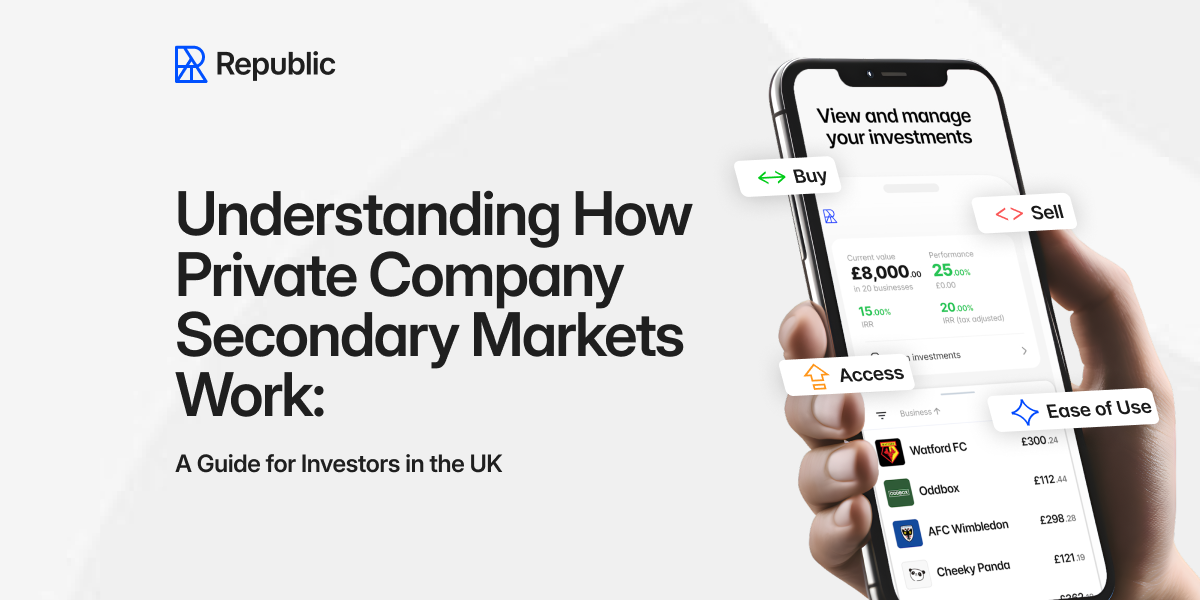
A private company secondary market is a financial ecosystem where existing shareholders sell their equity stakes in private firms to new buyers. This market operates through regulated investment platforms that facilitate transactions outside of traditional public stock exchanges, providing liquidity for early investors and employees. For eligible and institutional investors, understanding how private company secondary markets work offers a critical pathway to access high-growth companies before they reach an Initial Public Offering (IPO).
Key Takeaways
- Private company secondary markets allow shareholders to sell equity stakes to new buyers outside public exchanges.
- These markets provide essential liquidity for early employees, investors, and founders of private companies.
- The UK’s PISCES framework provides a regulated, legal structure for intermittent trading of private company shares.
- Separately, other secondary opportunities are available on platforms like Republic Europe. Investors must consider risks like illiquidity and valuation uncertainty when participating in private company transactions, including secondary trading.
The private company secondary market in the UK has entered a new phase defined by greater access, clearer regulation, and growing appetite from investors who want exposure to high-growth companies. Republic Europe is at the centre of that shift.
Below is a breakdown of what the secondary market actually is, how it works in the UK context, what has changed in recent years, and what investors should understand before participating.
Defining the Private Company Secondary Market and Its Functions
When a company raises capital through a new share issuance, that is a primary transaction: money flows from investors into the company in exchange for newly created shares. A secondary transaction is different. The company does not issue new shares. Instead, an existing shareholder sells their stake to a new buyer. The company receives no new capital; only ownership changes hands, funds flow to the seller of the shares, providing them with liquidity.
For public companies, this happens continuously on stock exchanges. For private companies, it has historically required private negotiation, manual legal documentation, and access to a network willing to transact. The friction was enormous, and the market was opaque.
Today, structured private market investment platforms are reducing both friction and opacity.
Primary Participants and Sellers in Private Secondary Transactions
The supply side of the secondary market is made up of people who have equity in a private company and want or need to create liquidity. That typically includes:
- Early employees whose options have vested over years but who have seen no liquidity event
- Angel investors and seed-stage funds looking to rebalance a portfolio or return capital
- Founders seeking partial liquidity to reduce personal financial concentration without triggering a full exit
- Early investors, including investors who backed companies via Republic Europe
Each of these sellers holds real economic value in a private company. The private secondary market is the mechanism through which these shareholders can access liquidity.
The UK Regulatory Framework: PISCES and Regulated Investment Platforms
In the UK, the Financial Conduct Authority (FCA) has been working to create clearer infrastructure for private market transactions. The Private Intermittent Securities and Capital Exchange System (PISCES), introduced under the FCA’s regulatory framework, is a significant development. The PISCES framework provides a defined, regulated structure for intermittent trading events in private company shares, giving a company led structure for secondary activity.
Republic Europe is now a Registered Auction Agent (RAA) on the London Stock Exchange’s Private Securities Market (PSM), which operates under the PISCES framework. This means Republic Europe can provide access for eligible investors to structured, time-limited secondary trading events on the PSM for private companies within a regulated environment. It is a meaningful step forward for the accessibility and legitimacy of private secondary investing in the UK.
Click here to learn more about the partnership between Republic Europe and the LSEG
Mechanics of Secondary Transactions on the Republic Europe Platform
Republic Europe’s investment platform provides a variety of secondary opportunities, e connecting investors who want to sell their private company shares with buyers from Republic’s investor community. This is done by either a secondary campaign or through Republic Europe’s Secondary Market. The mechanics are worth understanding before you participate, whether you are a buyer or a seller.
Secondary Campaigns
For Buyers
When Republic Europe brings a secondary opportunity to the platform via an investment campaign, you are purchasing an economic interest in shares that an existing shareholder already holds which on completion of the transaction will be held through Republic Europe’s nominee structure,
This nominee structure serves several purposes. It keeps the company’s cap table clean by consolidating multiple investors into a single entry. It allows investors to participate with smaller ticket sizes than would typically be viable in a bilateral secondary transaction. What you are gaining as a buyer is economic exposure to a private company at a stage of its development that was previously inaccessible. These are not early-stage bets on unproven ideas. Secondary opportunities on Republic Europe tend to involve companies that have already raised capital, built products, and demonstrated growth.
For Sellers
If you hold private company shares and are considering selling through Republic Europe, the process involves creating a campaign which provides an opportunity for investors to purchase the shares up to the value you are willing to sell. Republic Europe manages the legal and administrative complexity of the secondary transaction, including investor onboarding, and transfer documentation.
Key considerations for sellers:
- Right of First Refusal (ROFR). Most shareholder agreements give the company and existing investors the right to match any third-party offer before the sale proceeds to an external buyer. This must be addressed before any secondary transaction completes.
- Company consent. Private share transfers might require board approval or company sign-off.
- Valuation. Secondary pricing is negotiated based on the company’s most recent primary round valuation, comparable market data, and any applicable discounts for illiquidity or share class.
- Tax implications. Capital gains tax treatment in the UK and EU varies depending on the type of equity held, the holding period, and the jurisdiction. S/EIS investors should be particularly careful about minimum holding periods before selling, as an early exit can trigger clawback of tax relief. Please note that tax treatment depends on individual circumstances and may be subject to change in the future.
Structural Drivers Behind the Growth of Private Secondary Markets
The growth of the private secondary market is driven by long-term structural shifts in global finance. Several forces are driving it, and they are not going away.
Companies are staying private for longer. The average time from founding to IPO has extended significantly over the past two decades. Many of the most valuable technology and consumer companies in the world have remained private well past the point at which previous generations of companies would have listed. That means the most substantial value creation is increasingly happening in private markets, before have any access through public exchanges.
Equity compensation is now widespread. A growing number of people across the UK and Europe work at companies where a meaningful portion of their compensation is tied up in startup equity. Many of these individuals have legitimate financial reasons to want liquidity before an IPO that may be years away.
Institutional appetite for secondary exposure is rising. Pension funds, endowments, and family offices have been increasing their allocations to private markets for years. Secondary transactions give them a route to build exposure without waiting for new primary rounds.
Broadening investor interest. Perhaps most significantly, eligible investors are increasingly aware that public market returns have been compressed, and that the companies generating the most exciting growth are often not yet listed. The secondary market is one of the few mechanisms through which they can access that growth.
Key Risks and Considerations for Private Secondary Market Investors
Secondary investing in private companies is not the same as buying shares on a stock exchange. There are characteristics specific to this asset class that every investor should understand.
Even if you buy shares in a secondary transaction in a private company today, you will not be able to sell them freely tomorrow. Shares purchased on the secondary market remain private securities and may be subject to transfer restrictions. Your exit options are limited to a future secondary sale, an IPO, or an acquisition. You should only invest capital you can afford to have locked up for an uncertain period.
You are buying from a seller, not the company. Unlike a primary investment, your money does not go to the company. The company’s prospects and performance are what you are ultimately exposed to, but the transaction itself is between you and the selling shareholder.
Valuation is not guaranteed. Secondary pricing is negotiated and reflects the market’s view at a specific moment. The price you pay may be at a premium or discount to the last primary round, depending on conditions. Investing with a premium does not guarantee the company is at that valuation or will grow into it. A discount does not mean the investment is without risk.
Due diligence matters. Regulated platforms like Republic Europe provide disclosure documents and any known material information about the companies involved when it comes to secondary investment campaigns. Read them. Understand the business model, the competitive landscape, and the risks.
Republic Europe’s Track Record in Private Market Secondary Trading
Republic Europe has facilitated over £2.8 billion in investments, supported more than 2,200 companies, and has participated in 100+ full and partial company exits within the Republic Europe portfolio, £35 million traded on its Secondary Market in over 84,000 transactions. Past performance is not indicative of future results. These are not theoretical capabilities. They represent a track record of executing secondary transactions across a broad range of companies and investor types.
Our Growth Secondary campaigns give investors the opportunity to gain economic exposure to growth-stage private companies through structured secondary share purchases. Our membership of the London Stock Exchange’s Private Securities Market as a Registered Auction Agent means we can also provide eligible investors with access to PISCES-compliant intermittent trading events listed on the PSM, providing even greater optionality for companies and investors navigating the secondary landscape.
We operate within a dual-regulated framework: authorised by the Financial Conduct Authority in the UK and the Central Bank of Ireland under the EU Crowdfunding Regulations. That regulatory foundation is central to how we build trust with both the companies we work with and the investors who participate on our platform.
Conclusion: The Evolving Role of Private Secondary Markets
The private company secondary market in the UK is no longer a niche corner of institutional finance. It is becoming a core component of how private capital markets function, and how a broader range of eligible investors access opportunities that were previously out of reach.
Understanding the mechanics, the regulatory context, and the specific risks involved is the foundation of participating wisely. Republic Europe exists to make that participation as informed, structured, and accessible as possible.
Explore Secondary Investing on Republic Europe
Republic Europe connects investors with curated opportunities in growth-stage private companies. Browse current secondary campaigns, register for priority access to upcoming opportunities, access Republic Europe’s Secondary Market or learn how the platform works.
Frequently Asked Questions
What is the process for how private company secondary markets work?
Private company secondary markets work by allowing existing shareholders to sell their equity stakes to new buyers on regulated platforms. These transactions bypass traditional public stock exchanges, enabling liquidity for early employees and investors while offering buyers access to high-growth private firms before they reach an IPO.
How do regulatory frameworks support secondary trading?
Regulatory frameworks like the UK’s PISCES and the EU’s ECSP provide the necessary infrastructure for these rules to ensure that platforms like Republic Europe operate with oversight, providing investors with essential protections, standardized disclosure requirements, and a clear legal basis for conducting secondary transactions in private company shares.
Why is liquidity important for private company shareholders?
Liquidity is critical for early employees and angel investors who hold significant value in private companies but lack an exit path. By facilitating secondary sales, these markets allow shareholders to realize financial gains from their equity before a company completes a full exit or goes public via an IPO.
What risks should investors consider in secondary markets?
Investors should note that secondary assets are illiquid and subject to transfer restrictions. Unlike public stock exchanges, secondary pricing is negotiated and not guaranteed. Furthermore, due diligence is essential, as the disclosure requirements for private companies are generally less comprehensive than those mandated for publicly listed entities.
Risk Warning
WARNING: Investment in private company secondary markets entails risks, including the risk of partial or entire loss of the money invested. Your investment is not covered by a deposit guarantee scheme or by an investor compensation scheme.
Disclaimer: Republic Europe is authorised and regulated by the Financial Conduct Authority. This article is for informational purposes only and does not constitute investment, financial, legal, or tax advice. References to Republic Europe’s products and services are provided for informational purposes only and should not be considered a recommendation or an invitation to invest. Investments in private companies are high risk, illiquid, and you may lose some or all of your investment. Capital is at risk. Tax treatment depends on individual circumstances and may be subject to change.
Regulatory Note: References to UK and EU regulatory frameworks are intended as general information only and should not be relied upon as legal or regulatory advice. Investors should seek independent professional advice where appropriate.